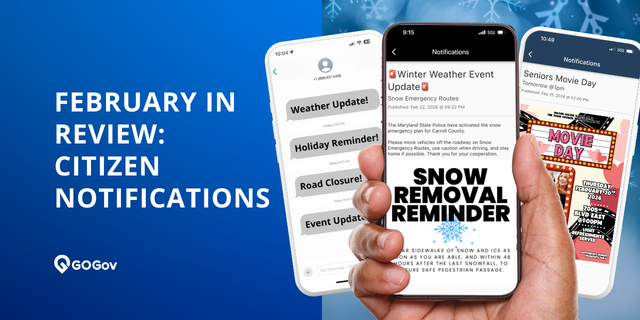
February is a short month — but local governments had a lot to say.
Across the GOGov platform, 250 agencies sent 2,330 citizen notifications in February 2026. That's an average of 9.3 notifications per agency over just 28 days, covering everything from winter storm alerts and water main breaks to community events and council meeting reminders. This post takes a look at what local governments were communicating, which channels they used to reach residents, and what the data tells us about how modern government communication is evolving.
A Busy Month for Local Government Communication
February's notification activity wasn't evenly distributed. The peak day was February 23rd, with 150 notifications sent across the platform — a surge likely tied to a combination of late-season weather events and end-of-month public meetings. Weekdays consistently drove the most volume, with Monday through Friday accounting for the overwhelming majority of activity. Weekends were significantly quieter, which tracks with how government offices operate.
The most active agencies in February were the Town of Guttenberg (NJ) with 58 notifications, followed by the City of Palmetto (GA) with 51, and the City of Hazard (KY) with 44. What's notable isn't just the volume — it's the consistency. The top senders averaged between 7 and 14.5 notifications per week, signaling that these agencies have built citizen notifications into their daily communications workflow, not just as a break-glass tool for emergencies.
What Governments Were Communicating
GOGov analyzed notification headlines across the platform and categorized them into 11 distinct themes. The breadth of topics illustrates just how versatile a citizen notification platform needs to be.
🏛️ Government / Council / Meetings — 379 notifications (16.4%)
The single largest category. Agencies used GOGov Notify to alert residents about upcoming council meetings, public hearings, commission agendas, and board sessions. Examples included reminders like "City Council Meeting Tomorrow" and "Pender County Board of County Commissioners Meeting." Transparency starts with showing up — and helping residents show up too.
🎉 Community Events / Recreation — 329 notifications (14.2%)
Local governments aren't just administrators — they're community builders. February saw hundreds of notifications promoting events like art shows, farmers markets, fundraisers, and seasonal programs. Agencies used GOGov to drive attendance and build connection, sending notifications like "3rd Annual Art in the Park and Craft Show 🎨" and "🌿 The Growers & Makers Market is Back!"
🚨 Public Safety / Emergency — 326 notifications (14.1%)
Urgent alerts were a major part of February's activity. Agencies used GOGov to notify residents about traffic accidents, water outages, road closures, and other time-sensitive safety situations. This category was nearly tied with Community Events — a reminder that residents rely on their local government to be the first voice they hear when something goes wrong.
🚧 Road / Traffic / Construction — 320 notifications (13.8%)
Road-related alerts were another top category, with agencies sending construction updates, closure advisories, and traffic detour notices. Real-time infrastructure updates — like "Road Closure Alert" and "UPCOMING TRAFFIC ADVISORY – W. BLUME ST" — are exactly the kind of proactive communication that builds public trust.
💧 Water / Utilities — 169 notifications (7.3%)
February brought a spike in water-related alerts, driven in part by winter conditions. The phrase "water main break" appeared 32 times across notification headlines, while "boil water advisory" appeared 12 times. Agencies used GOGov to keep residents informed the moment a water issue was detected — and again when service was restored.
❄️ Weather / Seasonal — 128 notifications (5.5%)
Winter storms were a defining theme of the month. The phrase "winter storm" appeared 48 times, while "snow removal" and "snow emergency" each appeared 24 times. Agencies in cold-weather regions leaned heavily on GOGov to get ahead of dangerous conditions and set resident expectations before the snow fell.
♻️ Waste / Recycling / Sanitation — 99 notifications (4.3%)
Trash pickup changes, recycling reminders, and yard waste updates rounded out the operational communication picture. These notifications might seem routine, but they're among the most immediately useful things a government can communicate — residents notice when collection day changes.
📰 Newsletter / General Update — 73 notifications (3.2%)
Many agencies use GOGov as their primary community newsletter channel, sending weekly digests and public works updates. Agencies like the Village of Yellow Springs sent consistent "Public Works Weekly Updates" — building a regular communications cadence that keeps residents engaged between urgent alerts.
💼 Business / Economic Development — 28 notifications (1.2%)
From job postings to downtown beautification surveys, some agencies are using GOGov to drive community participation in economic initiatives — a creative use of the platform that goes beyond traditional government communication.
🏗️ Permits / Code / Zoning — 15 notifications (0.6%)
Permitting reminders and code enforcement updates kept residents and property owners in the loop on regulatory matters.
🏥 Health / Wellness — 12 notifications (0.5%)
Mobile medical clinics, pet vaccination events, and blood drives — agencies used GOGov to promote community health programming and make it easy for residents to participate.
One Dashboard, Every Channel
One of the biggest differentiators of GOGov Citizen Notifications is true multi-channel delivery — all from a single platform. In February, agencies sent notifications across a wide mix of channels simultaneously, including:
- Mobile push notifications (via branded city apps)
- SMS / text message
- Voice calls
- Twitter / X
The most common combination was email + mobile push, which accounted for the largest share of notifications — meaning agencies are consistently reaching residents both in their inbox and on their phone. Many agencies went further, simultaneously publishing to Facebook, Twitter, and Instagram alongside digital notifications, maximizing reach without duplicating work.
This matters because residents aren't all on the same channel. Some residents check their city's Facebook page. Others rely on text messages. Others have the city's app installed and respond to push notifications. GOGov's multi-channel approach ensures that one message reaches everyone — wherever they are.
What February's Data Tells Us
A few things stand out from this month's activity:
Consistency beats volume. The agencies sending the most notifications weren't just reactive — they had built a regular rhythm of communication. The most consistent senders averaged 7–14 notifications per week, every week of the month.
February is operationally intense. Between winter storms, water main breaks, Presidents' Day office closures, and the natural rhythm of public meetings, February demands a lot from local government communicators. GOGov gives agencies the tools to respond quickly and communicate proactively.
Local governments communicate far more than alerts. The data makes clear that citizen notifications are being used for the full spectrum of community communication — meetings, events, sanitation, health, economic development, and more. The platform is as much a community engagement tool as it is an alert system.
Ready to Keep Your Community Informed?
Whether you're a city, county, township, or special district, GOGov Citizen Notifications makes it easy to reach every resident — across every channel — from one simple dashboard.
Learn more about GOGov Citizen Notifications →
.png)


.png)